Fresh red bleeding
Blood on tissue or in the toilet, often with bowel movements.
Piles can cause fresh red bleeding, itching, swelling or a lump that appears while passing stools. Many cases do not need surgery. The right plan depends on your symptoms, examination and the type or grade of haemorrhoids.
IMPORTANT TO KNOW
Seek emergency care now for heavy or continuous bleeding, large clots, fainting, severe dizziness or severe anal pain. Get prompt medical assessment for black tarry stools, unexplained weight loss, anaemia or a lasting change in bowel habits.
This website is not an emergency service. Bleeding can have several causes, including colorectal conditions requiring investigation.
Symptoms vary. Painful swelling or discharge may also point to other conditions that need examination.
Blood on tissue or in the toilet, often with bowel movements.
Tissue that appears during stools and may go back in afterward.
Moisture, mucus or difficulty cleaning the area.
Sometimes associated with an external haemorrhoid or a clot.
Sharp pain during and after stools can suggest an anal fissure. Recurrent pus or swelling needs assessment for infection or fistula.
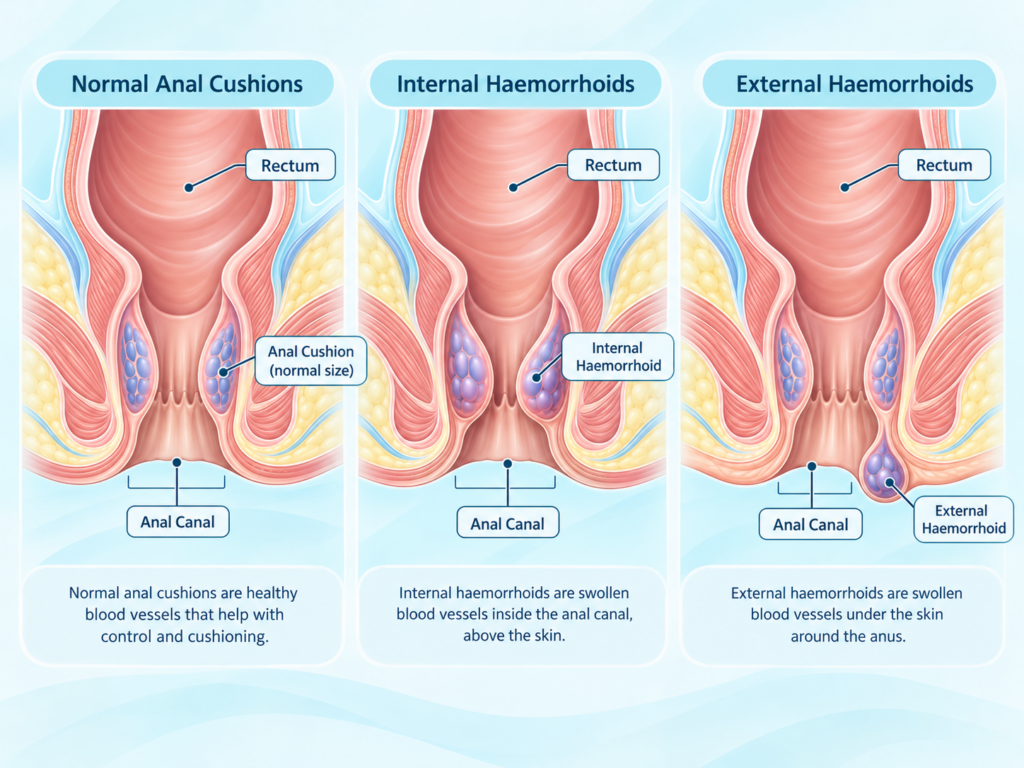 Haemorrhoidal cushions are normal anatomy; symptoms arise when they become enlarged or displaced.
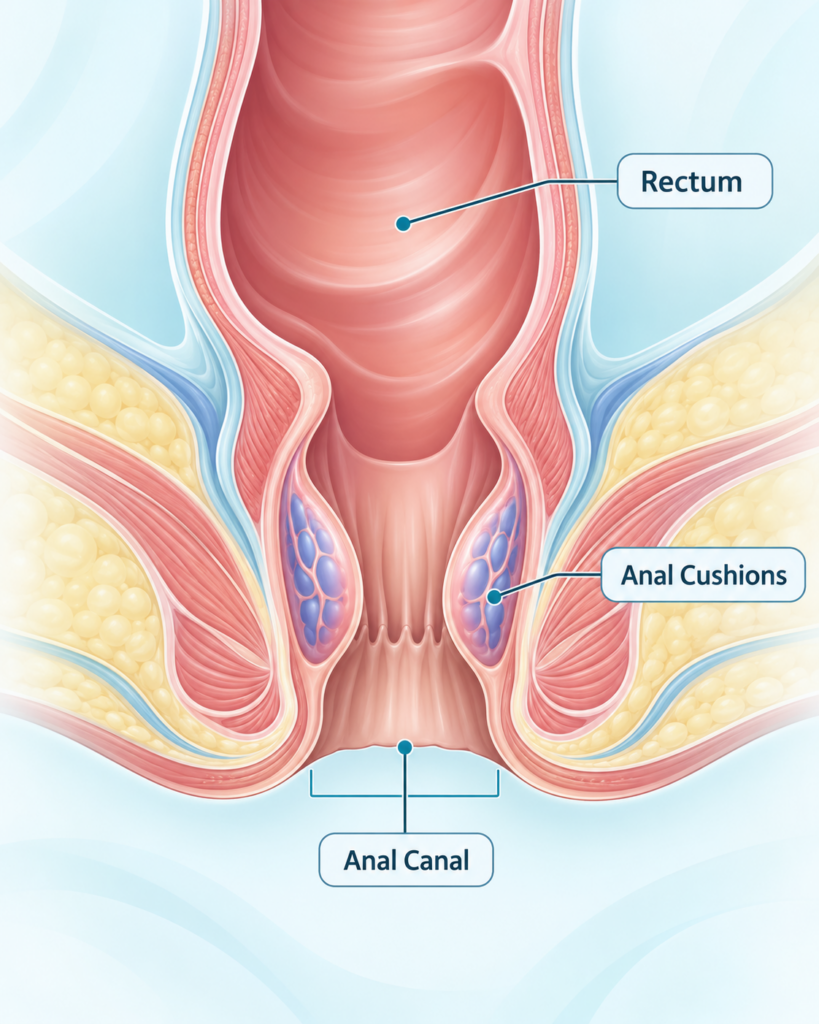
Haemorrhoidal cushions are normal structures in the anal canal that help with continence. They can become symptomatic when they enlarge, bleed or prolapse.
Internal haemorrhoids arise inside the anal canal and may cause painless bleeding or prolapse. External haemorrhoids are near the anal opening; a thrombosed external haemorrhoid can cause sudden painful swelling.
Constipation, hard stools, straining, prolonged toilet sitting and pregnancy may contribute to symptoms. Examination is needed to distinguish piles from other anal conditions.
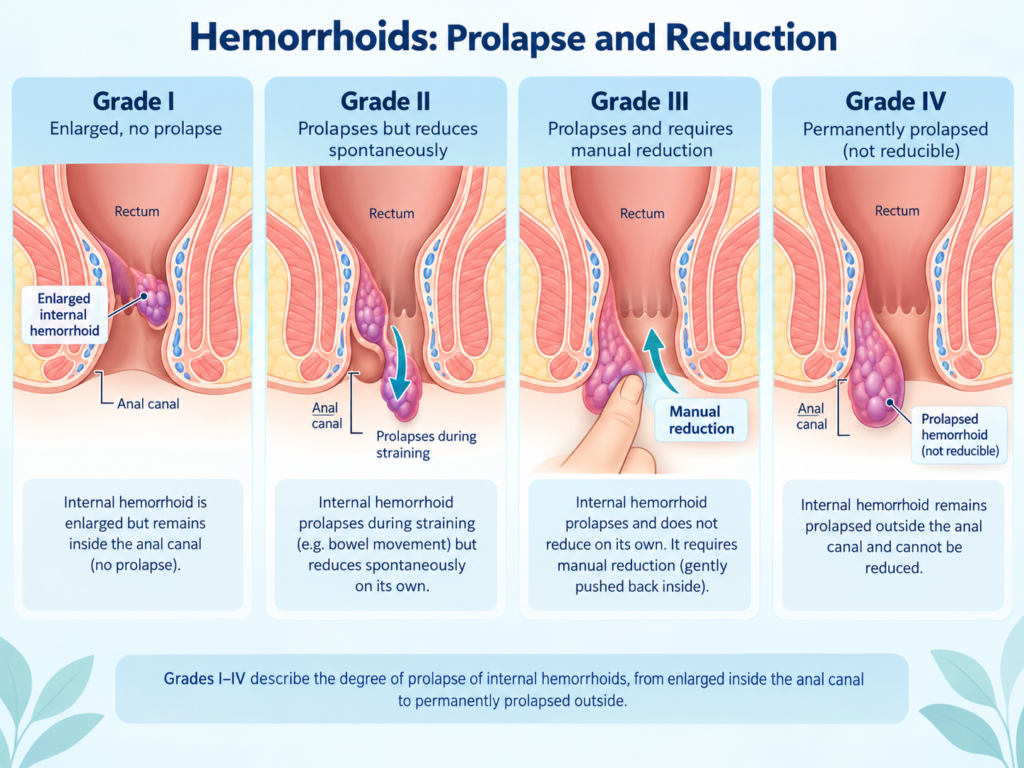
Understand the grades of internal piles →The grading describes prolapse of internal haemorrhoids, not simply how painful they are. Grade alone does not determine treatment.
Enlarged internal cushions that do not protrude outside the anus. Bleeding may occur.
Prolapses during straining or stools, then retracts spontaneously.
Prolapses and needs to be gently pushed back in.
Remains prolapsed and cannot be pushed back inside.
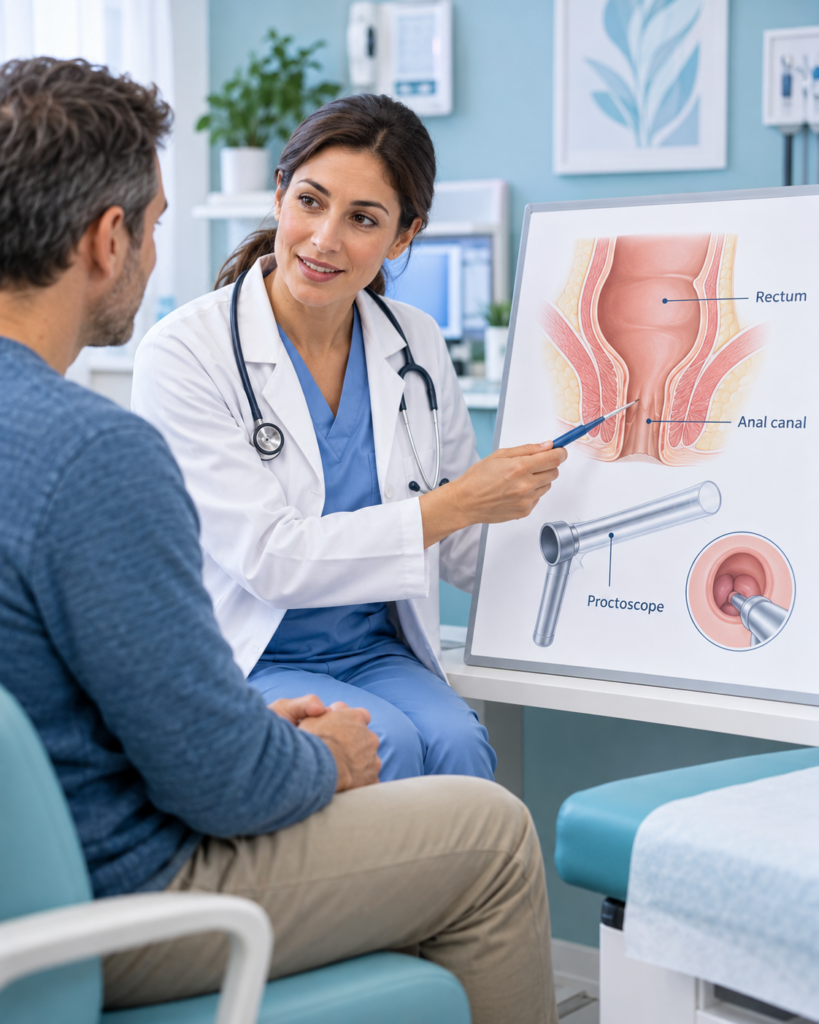
Not every patient needs every test. The plan depends on symptoms, examination and the possibility of other causes of bleeding.
Bleeding, pain, prolapse, constipation, previous procedures, medication and relevant family history.
External inspection and a digital rectal examination when appropriate and tolerated.
Selected patients benefit from looking inside the anal canal to identify internal piles or another source.
Persistent or unexplained bleeding, anaemia, concerning bowel changes or individual risk factors may call for further bowel evaluation.
Often, yes. Dietary and bowel-habit changes are first-line management for many patients with symptomatic haemorrhoids.
Temporary medicines or creams may ease symptoms, but ongoing bleeding or prolapse should still be assessed.
Regular fibre intake, hydration, movement and appropriate stool-softening measures can make bowel movements easier.
If bleeding continues, prolapse worsens, you develop significant pain or home care is not helping, obtain an examination.
Discuss your symptoms →No single procedure is suitable for everyone. Treatment considers internal versus external disease, grade, bleeding, prolapse and previous care.
Fibre, fluids, constipation treatment and short-term symptom-relief measures are often appropriate initially.
Read conservative advice →An elastic band treats selected internal haemorrhoids. Often considered for Grade I–II and some Grade III disease.
Compare approaches →Other office procedures may be options depending on the clinical findings and treatment priorities.
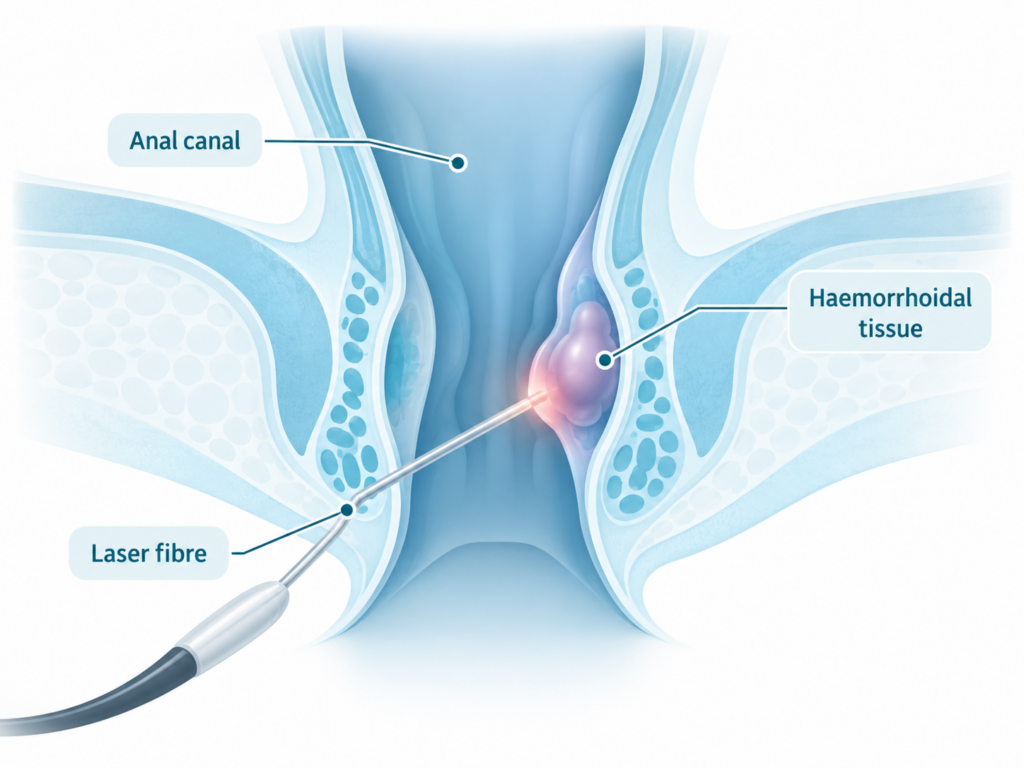
View comparison →Selected laser techniques aim to treat haemorrhoidal tissue; suitability, evidence, risks and recurrence should be discussed.
Learn about laser →Considered for selected significant external or combined internal and external disease, including some Grade III–IV cases.
When surgery helps →Doppler-guided haemorrhoidal artery ligation and other methods may be discussed for suitable presentations.
Discuss your options →Sometimes, but not always. Laser is a tool used in certain haemorrhoid procedures. The decision should reflect prolapse, external components, previous treatment, available evidence and your preferences.
Potential advantages of some less-invasive techniques can include limited tissue cutting and a shorter recovery in selected patients. However, outcomes vary, and laser is not proven to be the best approach for every grade or a guarantee against recurrence.
For some people, a rubber band procedure or conventional excision is more appropriate. Discuss expected discomfort, costs, long-term results, possible complications and alternatives before deciding.
These are broad patterns, not prescriptions. A surgeon may recommend something different after examination.
| Treatment | Often discussed for | Key consideration |
|---|---|---|
| Diet and bowel-habit changes | Mild symptoms; first-line care across grades | Controls symptoms and reduces straining; does not always resolve major prolapse. |
| Rubber band ligation | Selected symptomatic Grade I–II, some Grade III internal piles | Effective office treatment; may need repeat treatment. |
| Injection / infrared treatment | Selected internal piles, depending on findings | Outcomes and retreatment rates differ by method. |
| Laser-assisted technique | Selected internal haemorrhoidal disease | Not suitable for every grade; compare efficacy, recurrence and cost. |
| Excisional haemorrhoidectomy | Selected external or combined symptomatic Grade III–IV disease | Effective for substantial disease; typically requires more recovery and pain management. |
The recovery plan depends on whether you have an office procedure, a laser-assisted procedure or excisional surgery.
Contact your treating team for unexpected fever, worsening pain, difficulty passing urine or bleeding more than advised. Seek urgent care for heavy bleeding or faintness.
Ask about the expected pain, type of anaesthesia, wound care, time off work, recurrence risk and possible complications.
Treatment does not eliminate the importance of good bowel habits, even after a successful procedure.
Request an assessment →
MBBS · MS (General Surgery) · FMAS · DMAS · SAGES (USA) · WALS (UK)
Consultant Surgeon with practice focus on laparoscopic and bariatric surgery, laser proctology, upper GI endoscopy and colonoscopy.
For piles, the approach begins with an accurate examination and an explanation of non-surgical, office-based and operative options where relevant.
Consult Dr Jadhav ↗Answers to common questions about symptoms, grades, laser and recovery.
Piles are enlarged or symptomatic haemorrhoidal cushions in or around the anal canal. They may cause bleeding, prolapse, itching or discomfort.
Yes. Piles is the common term for haemorrhoids.
No. Many people improve with fibre, fluids, stool regulation and better toilet habits. Office treatments or surgery are selected according to symptoms, examination and response.
Yes. Internal piles often cause bright red bleeding without significant pain. But rectal bleeding should not automatically be attributed to piles.
The grades describe internal piles and how far they prolapse: Grade I does not prolapse; II reduces on its own; III needs manual reduction; IV cannot be reduced.
No. Laser-assisted techniques may be suitable for selected patients, but their role, outcomes and recurrence risk should be compared with conservative, office-based and conventional surgical options.
A small band is placed around selected internal haemorrhoidal tissue to reduce its blood supply and help treat bleeding or prolapse. It is an office-based treatment for suitable cases.
Excisional haemorrhoidectomy may be considered for selected significant external or combined internal/external haemorrhoids, especially symptomatic Grade III–IV disease or cases not improved by other options.
Yes. Symptoms or haemorrhoids may recur after any treatment. Constipation management, fibre and follow-up remain important.
Not everyone needs a colonoscopy. It may be appropriate when bleeding is persistent or unexplained, or there are anaemia, altered bowel habits, risk factors or other concerning features.
It varies greatly by procedure, associated conditions and activity level. Your surgeon can explain the expected pain control, wound care and return-to-work plan for the chosen treatment.
Bring prior prescriptions, colonoscopy or proctoscopy reports, laboratory results, details of previous piles treatment and an up-to-date medicine list. Do not stop blood thinners without advice from the prescribing clinician.
Arrange a consultation to confirm the diagnosis, assess the grade and discuss treatment choices suited to your situation.